

How do you see?
hint - it's not just with your eyes.

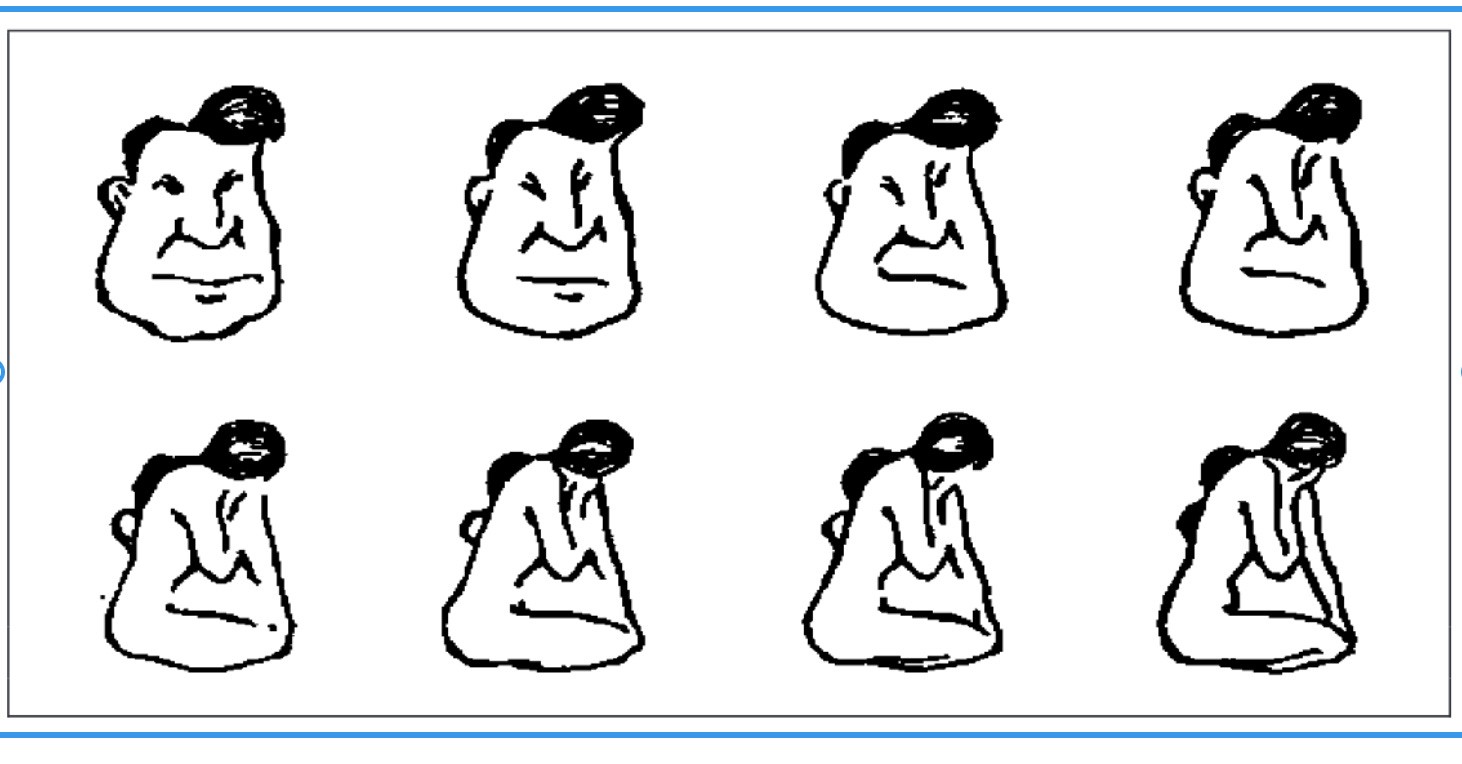
When is it a long faced man and when is it a woman's nude body from the side?
This post is a continuation of an earlier exploration of our human susceptibility to visual error. That post can be found here.
The opening question should be asked slightly differently. Rather than when is it one or the other, instead you should consider it a highly personalized question: when do you see a long faced man and when do you see a woman's nude body from the side?
It matters how this question is asked because this drawing demonstrates just how important your mindset, your mental lens, matters. How you interpret the visual world is largely determined by your mind and not your eyes. Your personal viewpoint creates what you see.
The illusion featured above is from an article I read many years ago, one that has occupied a central place in my personal learning of pathology. (Unlike spycraft or pathology, there is no right answer to this image! There will be no test, just self reflection).
In this article from 2006, Dr. McLendon, a neuropathologist, wrote about what can be learned from the cognitive processes of decision-making by studying how CIA analysts process information to make decisions.* For the Mindset illusion illustrated above, Dr. McLendon highlighted how neuropathologists might tend to 'see' a specific cell type over an other (an oligodendrocyte and not just an astrocyte). Just like these neuropathologists, CIA analysts need to process incomplete and ambiguous information and use it to make important decisions.
Both of these professions require a rational examination of cognitive biases in order to correctly interpret the world.
This particular illusion of mindset demonstrates that our first impressions are resistant to change. This image is a spectrum of shapes and identities. If I am somehow biased to perceive a face (most humans are), or 'maleness' vs 'femaleness', this mental lens may change when/at what image I see one or the other. *
To become fully aware of our world - to be a good notice-taker - we need to realize that our mindset (any mindset) is unavoidable. It might even be hard wired into our cognition.
So we can’t always prevent our biases from coloring our perceptions. But we can recognize that once our impression is formed, we need to vigorously examine it. My advice? Find specific evidence that questions your powerful first impression.
Gathering this evidence is akin to generating a differential diagnosis for a medical condition, a habit doctors are relentlessly trained in. How would you, an expert in your own world, gather this evidence?
»>Through close study of the world, aka deliberate observation through simple tools. For myself, creativity is what enlivens these practices and ties the observations together.
Creativity based in close study of the world is like mental hygiene. When we take note - write in a journal, draw or paint- we open ourselves to new evidence. Sometimes this evidence contradicts our first impression. And that can be a new solution.
* How does this relate to the decision making of pathology? Much like what we can encounter in pathology things are not always Black or White. It is also important to consider our mindset when reviewing cases. It How much do our first impressions color our interpretation? I have looked at biopsies from well-known people - how does this cloud my assessment? Or when looking at a biopsy from a child the same age as one of mine - I feel a tug of recognition about the pain behind this tissue. Do I treat the question before me any differently?
To offset this from creeping in, many pathologists prefer to not know anything about the case when first reviewing it. Only after we've examined the slides with what we hope to be a truly open (or full) mind, then we read about the patient's age, gender and background. Other times, perhaps in the frozen section lab for stat evaluation, the opposite is true. It can be important to read thoroughly about the case ahead of time. Brain tumors and breast cancers need to be correlated with imaging studies, which can help a pathologist put on the proper mindset before reviewing the slide.