



I’m delighted to share writing from my guests this season. Please enjoy this essay from Dr. Jennie Lightweis-Goff, featured guest on Episodes 4 and 7.

I was born as a hysteric on August 31, 1988, a few weeks after my ninth birthday. The excitement of gifts and compensatory parties — designed to make me forget that kids born during the regular school year had roomfuls of classmates sing to them — had faded. But one pleasure never left: the excitement of standing on my toes behind my mother on the grocery checkout line to see the headlines and black and white images of the trashy tabloids. These days, we remember The National Enquirer or mock the headlines of The New York Post. (Other women have nicknames for their situationships; I’ve said goodbye to more than one man by writing him a rhyming hypothetical headline about our star-crossed affair.)
But there were many more newspapers and magazines then. Glossy and nubby, the raw and the cooked. Just above my eyeline, I see the misty edges of a vintage photograph. I lean back as I climb to the crest of my toes. (Henri had an acute attack and fell into his grave, read the mnemonic poster on the wall of my French classroom, designed to remind us of the direction of accent marks. Acute backward and grave forwards.) When I see the tabloid cover pictures in their fullness, I shift backwards and then forward in terror; I have an acute attack and fall into someone else’s grave. It’s not Bat Boy or Reanimate Elvis, but an image of five dead women, four on morgue slabs with their throats slashed, one laying on her side in bed. The wall behind her is splattered with viscera; sometime later, I remember thinking thank God it was in black and white. All of our metaphors are photographic now, lensed and pinched and zoomed into focus. I inspected the fifth woman, the outlier. The men who found Mary Jane Kelly — Jack the Ripper’s final victim — on November 8, 1888, knew her by her eyes and teeth. The rest of her face had collapsed into the bedding. At the inquest, the witnesses averred that they would never recover from the sight.
The twentieth-century tabloid — I do not remember which — published a grid of “the five” in dubious honor of the centenary of Jack’s first kill: Polly Nichols, on August 31, 1888. For the rest of my life, I suspect these images will remain my ultimate information hazard. I asked my mother for the details. I point at what I’ve seen. She will advance no further into the story than I have traveled, here, alone. The orderly fear came later, with trigger warnings and blurred Reddit clicks. We lived in a different world then: only the sensory world, without digital wallpaper or static interference. I could see the skinless chicken thighs laying on the conveyor belt, passed from my mother’s hands to the cashier’s and then to mine, as Mom told me to bag the groceries.
Later, at the dinner table, I bite and see the flash of red down near the chicken bone. I taste the metal blood spray on Mary Jane Kelly’s wall and then, for the first time, I faint.
***
When I am afraid --- tipping in and out of a manic state — I feel it first in my aversion to chrome rows of meat in the grocery store. Before long, I am checking locks and scanning the faces of my loved ones for signs of body-snatchers, some novel identity theft. In the age of peak true crime, I recognize my sisters. In Savage Appetites, Rachel Monroe describes a lifetime of falling into “murder funks” when depression leads her — like a lightbulb on insomniac nights — to Dennis Rader’s daughter’s memoir or to Jeffrey Dahmer’s Wikipedia page. In “Sexy French Depression,” a song from the beloved musical comedy Crazy Ex-Girlfriend, Rachel Bloom sings while reclining in a bed that “smells like a tampon” and reading a book on John Wayne Gacy. (The lyrics are written in inimitable, subtitled French). But we don’t have much in common. They fear that the killer is under the bed, and they use the shot of energy to shake the bed-skirt and check. Once they leave the house, they’ll use books by Ann Rule and Maureen Callahan to shield themselves from men who stand too long near their car doors in parking lots. But I’m not afraid of the predator; I’m afraid of the body he leaves behind. I could enter my own bedroom and find Mary Jane Kelly, slashed and cubed, between my sheets. Maybe she will turn slightly. The dangling eyeball will gaze at me for a moment, and I will recognize my own mutilated face.
The distinction, I think, is the line between hysteria and its near-cousins: mania, anxiety, and depression. Hysteria is a form of identification; it is mimetic, of course, but the hysterical self becomes unstuck, like deteriorating glue in the binding of a book, from its body. Freud, who self-diagnosed as a hysteric, saw himself in talented Dora. By contrast, depression has become a lazy catch-all diagnosis for disordered thinking; we have filed down its edges to make it fit, now that hysteria seems dated and borderline seems owned as a colloquial denunciation for a messy bitch. The spread of the depression diagnosis is, of course, medicalized in a way that might remind us of hysteria – the thing we’ve allegedly overcome, as smart people in a modern society.
One does not have to be RFK, Jr. to think that SSRIs are over-prescribed. After all, the first great chronicler of Prozac was the late Elizabeth Wurtzel. She was a feminist, an unsung genius, a Dionysian anti-Didion. An iconic New Yorker who wore cashmere sweaters doused with perfume and stained with her favorites: Revlon’s Cherries in the Snow and Mr. Softee ice cream. When she wrote Prozac Nation, Wurtzel noted that there were 6 million prescriptions in America alone, after just a few short years on the market. “As a Jew, I had always associated that precise number with something else entirely,” she wrote. The number pivots and points like a knife poised to slice a carotid artery.
Her second book, Bitch: In Praise of Difficult Women, is a catalog of danger; she acknowledges sympathy for Amy Fisher and Delilah, but real identification with girls who died ugly: Cathy Earnshaw and Margaux Hemingway and Zelda Fitzgerald. The stereotypical girl-on-girl crushes don’t hold much lure for her, and when she turns to acknowledge Sylvia Plath, it is to say that there’s “no such creature as a ‘submissive, sympathetic depressive,’” despite the endlessly circulated images of the poet as a trapped and hapless wife. She is not the unwashed Esther Greenwood of The Bell Jar, but a “hot-blooded madwoman….with bloody red lipstick,” the kind who looked at dead bodies and found in them some perfection, as in the poem “Edge” (1963). We have misunderstood her, Wurtzel seems to say, or misunderstood diagnosis entirely. “Depression, the disease of not feeling, starts to manifest itself as….hysteria…the disease of feeling too much,” she writes. And when we fail to see these categories – to imagine one as wholly obsolete, replaced by our superior knowledge – there is much we fail, symptoms we ignore, drugs we fail to research, and words that swim away from meaning.
Not long ago, my friend Amy arrived at my book release party with a 5-foot black and cream striped scarf wrapped in tissue paper and stuffed into a storage bag. The black fabric has a kind of lavender undertone, like the oil-slick dye jobs back in the 90s, when every girl had a copy of Prozac Nation tucked in her messenger bag. The scarf had belonged to Wurtzel, been purchased from her estate’s sale by another friend, then passed to Amy and never worn. I could just smell cigarettes, Amy told me, even after a second cleaning. I smelled nothing but perfume. Less the scent of a ghost who just passed through the room than the heavier business of your grandmother’s cut glass flacons. I held it for a long time before I slipped it around my neck, still fearful of the hysteric’s “secondary identification,” which we are too quick, I think, to name as narcissism. I wear it when I am full of fear and choose, nonetheless, to be foolhardy. When I rise from my bed with the wounds still in bloom.
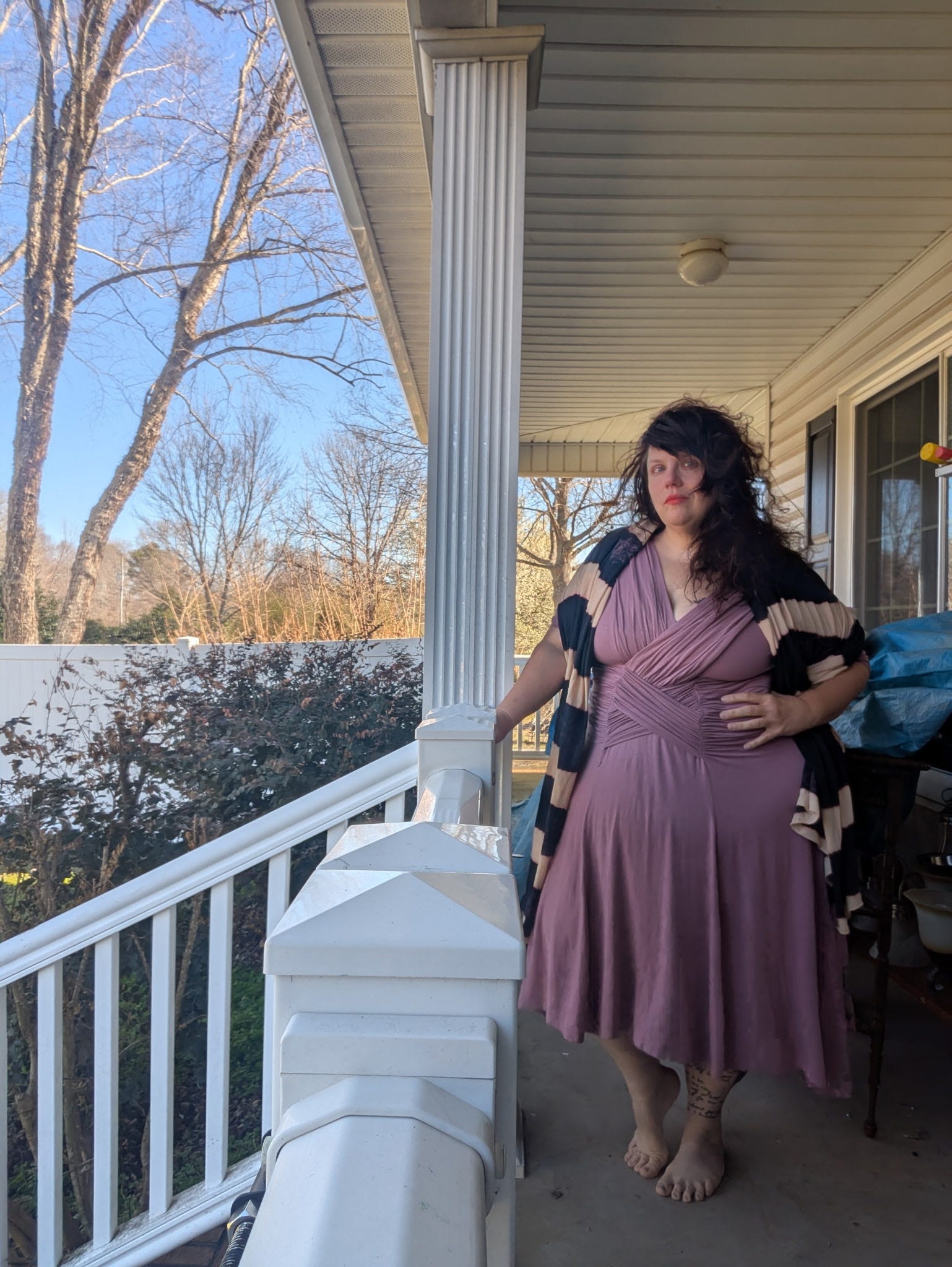
Are you following Jennie Lightweis-Goff? She is a flâneuse, scholar, and writer. Jennie in jammies, Dr. LG on the dotted line.
Author of Blood at the Root (2011), Captive City (2024), Porgy's Cart (2026), and The Chef's Sabbath (soon).
 | A guest post by
|